
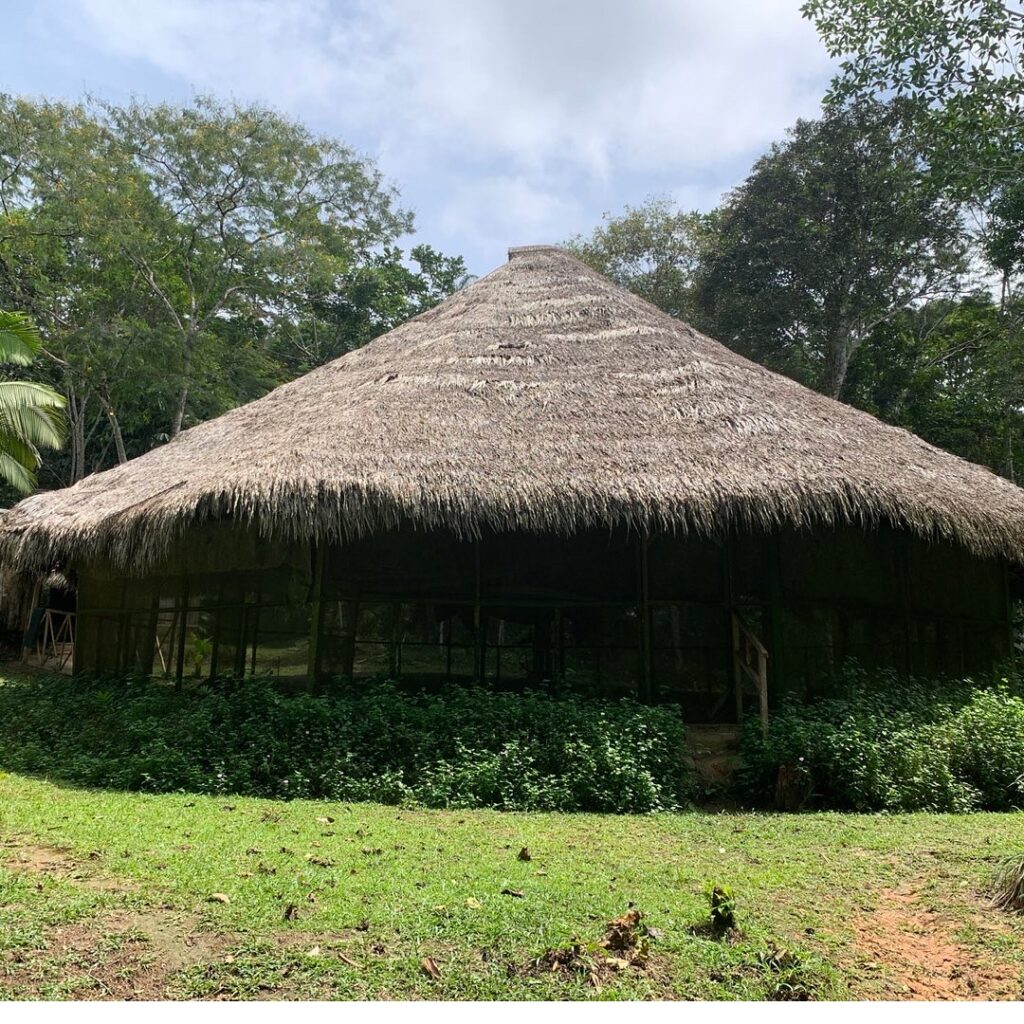
In the Amazon, ayahuasca is not simply a drink, a ritual object, or a modern curiosity. It belongs to a much deeper world of memory, ceremony, and relationship. To speak about the history of ayahuasca is to speak about the Indigenous peoples of the rainforest, their knowledge systems, and the continuity of sacred practices that have survived through time.
Today, ayahuasca is widely known across the world. But long before outsiders began asking about it, the brew was already part of living Amazonian traditions. Its meaning was not created in retreat centers, books, or online conversations. It was carried through generations by healers, elders, communities, and oral knowledge rooted in the forest itself.
What Is Ayahuasca?
Ayahuasca is a traditional Amazonian brew prepared most commonly with the Banisteriopsis caapi vine and, in many contexts, companion plants such as Psychotria viridis. Preparations can vary depending on the region, the healer, and the cultural tradition.
The word “ayahuasca” comes from Quechua and is often translated as “vine of the soul” or “vine of the dead.” Even so, this well-known name does not fully capture the diversity of meanings the brew carries among different peoples of the Amazon. Not all communities use the same language, the same interpretation, or the same ceremonial structure.
Deep Roots in Indigenous Amazonian Life
The history of ayahuasca is inseparable from the history of Indigenous Amazonian cultures. While exact timelines are difficult to establish with certainty, oral traditions and ethnographic records point to a long-standing ceremonial use of the brew across different parts of the Amazon Basin.
Among various Indigenous peoples of Peru, Brazil, Colombia, Ecuador, and nearby regions, ayahuasca has been used in ritual, healing, guidance, and spiritual diagnosis. It has never belonged to one single tribe, one single story, or one single method. Rather, it has appeared across different cultural worlds, each with its own songs, meanings, restrictions, and forms of preparation.
This is important to understand. Ayahuasca is not one fixed tradition. It is better understood as a family of traditions connected by the forest, by ceremony, and by the role of visionary knowledge in Amazonian life.
Indigenous Peoples and Traditional Use
Many Amazonian cultural groups have preserved ceremonial relationships with ayahuasca or related visionary plant traditions. These include, among others, peoples such as the Shipibo-Konibo, Asháninka, Shuar, Kichwa, Yaminahua, and Huni Kuin. Each tradition has its own worldview and should be understood on its own terms.
In many of these contexts, ayahuasca has traditionally been used for healing, energetic cleansing, spiritual guidance, diagnosis of imbalance, community protection, contact with the world of spirits or ancestors, the training of healers, and insight for decision-making or social harmony.
Its role has often gone far beyond individual experience. In many traditions, ayahuasca belongs to a wider spiritual ecology in which plants, songs, visions, and the natural world are understood as part of a living relationship.
The Role of the Healer
Historically, ayahuasca has often been guided by specialists: healers, shamans, vegetalistas, curanderos, or other ceremonial practitioners depending on the region and the cultural language. These figures were not simply serving a brew. They were working within disciplined systems of plant knowledge, ritual responsibility, dietary practice, and spiritual training.
In many Amazonian traditions, healing knowledge is not separated from ethics, respect, or preparation. The use of ayahuasca has often been accompanied by dietas, plant studies, songs, fasting, restrictions, and a careful relationship with intention.
This is one reason why traditional use cannot be reduced to the brew alone. Ayahuasca has historically belonged to a much larger ceremonial framework.
Ayahuasca Through Colonial Pressure and Social Change
Like many Indigenous traditions, ayahuasca practices did not exist outside history. Colonization, missionary pressure, violence, land dispossession, and cultural marginalization affected many Amazonian peoples and their ceremonial worlds. In some places, traditional practices were suppressed, stigmatized, or forced into secrecy.
And yet, ayahuasca endured.
Its continuity across generations is part of what makes its history so meaningful. The survival of ayahuasca traditions reflects not only spiritual strength, but cultural resilience. It reflects the determination of Indigenous communities to preserve ways of healing, knowing, and relating to the forest despite immense historical pressure.
In some regions, ayahuasca also became more visible through mestizo vegetalismo and syncretic healing traditions, where Indigenous knowledge interacted with changing social realities. This added new layers to its history while preserving deep roots in Amazonian cosmology.
From the Forest to the World
In the twentieth and twenty-first centuries, ayahuasca began attracting wider attention beyond the Amazon. Researchers, spiritual seekers, writers, and travelers became increasingly interested in its effects, symbolism, and ceremonial context. This global visibility brought both recognition and distortion.
On one hand, broader interest has encouraged many people to learn more about Amazonian traditions and the value of Indigenous knowledge. On the other hand, it has also led to commercialization, simplification, and misunderstanding.
To understand ayahuasca responsibly, it is essential to remember that its origins are not modern, generic, or ownerless. They are historical, cultural, and rooted in the lives of real peoples who have carried these practices through generations.
Why History Matters
The history of ayahuasca matters because it changes the way we approach it.
Without history, ayahuasca can easily be misunderstood as a trend, a product, or a private experience detached from culture. With history, it becomes possible to see it for what it has long been in the Amazon: part of a sacred tradition of healing, vision, discipline, and relationship.
History also teaches humility. It reminds us that the wisdom surrounding ayahuasca did not begin when the outside world discovered it. It existed long before, shaped by peoples whose knowledge came not from theory alone, but from lived continuity with the forest.
Final Reflection
Ayahuasca is part of a living historical tradition that belongs to the cultural memory of the Amazon. Its story is inseparable from Indigenous resilience, ceremonial knowledge, and the sacred relationship between human beings and the natural world.
To speak about ayahuasca with respect is to honor that history, not as something distant or romanticized, but as something still alive, preserved in songs, rituals, teachings, and communities that continue to carry the wisdom of the forest forward.
Understanding ayahuasca begins not with fascination, but with respect.