
For many people, one of the biggest questions before attending a retreat is simple: what actually happens during an ayahuasca ceremony?
This is a natural question. For some, the ceremony feels mysterious. For others, it brings curiosity, uncertainty, or even fear. While every experience is different, it helps to understand the general structure of a ceremony and the spirit in which it is traditionally approached.
An ayahuasca ceremony is not usually treated as entertainment, spectacle, or performance. In traditional Amazonian contexts, it is approached with seriousness, respect, and intention. It is a space where silence, presence, music, prayer, and inner process may all become part of the experience.
Understanding what to expect does not remove the mystery completely. But it can help you arrive with more calm, humility, and trust.
Before the ceremony begins
The process usually begins before anyone drinks.
Participants may be invited to gather quietly, settle into the space, and prepare themselves inwardly. Depending on the tradition and the retreat setting, there may be moments of silence, guidance from the facilitator or healer, prayer, or simple instructions about how to remain present during the night.
This part matters more than many people realize. Ceremony often begins not with the cup, but with the atmosphere. The quality of attention in the room can shape the experience deeply.
In many settings, people are encouraged to remain quiet, avoid unnecessary conversation, and enter the space with respect.
The ceremonial space
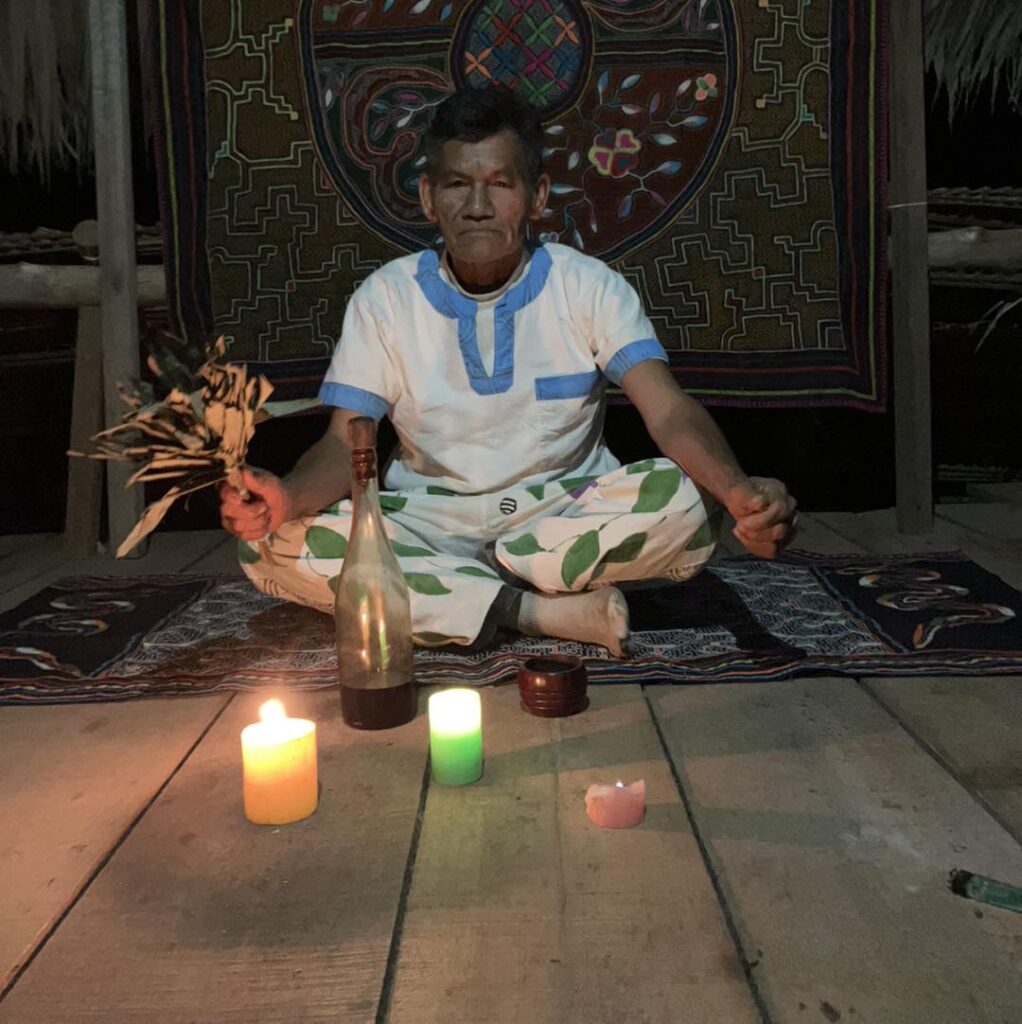
The ceremony often takes place in a maloca or another dedicated space prepared for the work. The environment may be simple, natural, and intentionally calm.
You may notice low light, a quiet atmosphere, mats or resting places, buckets nearby, and a general feeling of stillness. The space is usually arranged to support inward attention rather than outward distraction.
For many first-time participants, simply entering the ceremonial space can already feel different. There is often a sense that the night asks for presence, not performance.
Drinking the medicine
When the time comes, participants are usually invited one by one to receive the ayahuasca.
The amount, timing, and way it is served depend on the healer, the tradition, and the retreat context. This part is generally approached quietly and with respect.
For some people, this moment carries strong emotion. For others, it feels simple and calm. Some come with prayer, some with nervousness, and some with deep curiosity.
There is no perfect way to receive the experience. What matters most is sincerity and respect.
Waiting and entering the process
After drinking, there is often a period of waiting.
This can feel peaceful, uncertain, intense, or very still depending on the person. Some people begin to feel physical or emotional shifts relatively soon. Others may wait longer. There is no correct timeline, and comparison is rarely helpful.
This part of the night may invite patience.
You may begin noticing changes in the body, the breath, the emotions, or the rhythm of thought. Some people feel introspective. Some feel alert. Some feel vulnerable. Some feel nothing at first.
The beginning is often less about forcing something to happen and more about allowing the process to unfold.
Silence, music, and icaros
One of the most meaningful parts of many ayahuasca ceremonies is the role of sound.
In traditional Amazonian contexts, healers may work with icaros — sacred songs used within ceremony. These songs are not simply background music. In many traditions, they are understood as part of the healing and guiding process.
The use of silence can be just as important.
There may be moments when the room feels very quiet, and moments when singing, prayer, or other ceremonial sounds become central. For many participants, this can shape the emotional and spiritual depth of the night.
Even if you do not fully understand what is happening, it often helps to listen carefully rather than analyze too quickly.
Physical sensations and purging
People often ask about purging because it is one of the most talked-about aspects of ayahuasca.
Purging can happen in different forms, and not every person experiences it in the same way. In traditional settings, it is not usually seen only as a physical reaction. It is often understood as part of a process of release.
For some people, the night may bring physical discomfort, emotional intensity, restlessness, or moments of vulnerability. For others, it may feel surprisingly quiet. Some may purge strongly. Others may not purge at all.
It is important not to reduce the ceremony to one outcome.
The experience is not measured by whether a person has intense visions, strong physical release, or dramatic sensations. Sometimes the deepest ceremonies are not the loudest ones.
Emotional and inner experience
Ayahuasca ceremonies can bring many kinds of inner experience.
Some people describe emotional release, personal memories, moments of clarity, symbolic imagery, or a deep sense of self-confrontation. Others describe prayer, insight, silence, grief, gratitude, or the feeling of seeing their life from a different perspective.
Not every ceremony is visionary in the same way. Not every ceremony feels gentle. Not every ceremony produces immediate understanding.
Sometimes the experience feels beautiful. Sometimes it feels difficult. Sometimes it feels confusing before it becomes meaningful.
This is why respect is so important. The ceremony is not always comfortable, but many people find that it brings them into contact with what has been ignored, buried, or waiting to be seen.
The importance of surrender
Many first-time participants arrive wanting to understand everything as it happens.
This is natural, but ceremony often asks for something different. It asks for presence more than control.
Trying to force a certain kind of experience can create tension. It often helps more to breathe, listen, remain respectful, and allow the process to unfold in its own rhythm.
Surrender does not mean passivity. It means releasing the constant need to manage the experience and allowing yourself to stay in honest relationship with what arises.
Support during the ceremony
In a well-held retreat setting, the ceremony is not simply left to chance.
Facilitators, healers, or support staff may be present to help maintain the container of the night. Their role may include guiding the space, observing participants, offering support when appropriate, and helping the ceremony remain safe and respectful.
For this reason, trust in the retreat team matters.
A serious ceremony is not only about the medicine itself, but about the care, discipline, and responsibility surrounding it.
When the ceremony begins to close
Toward the end of the night, the intensity may begin to soften.
Some people feel quiet and reflective. Others feel tender, tired, grateful, or emotionally open. The closing of a ceremony is often gentle, but it can still carry depth.
What remains afterward may be just as important as what happened during the peak of the experience.
In many cases, the ceremony does not end when the songs stop. It continues in the silence that follows, in the way you sleep, in the thoughts that stay with you, and in what begins to unfold the next day.
The morning after
For many people, the morning after ceremony feels different.
It may bring relief, softness, clarity, emotional sensitivity, or quiet reflection. Sometimes what seemed confusing during the ceremony begins to make more sense later. Sometimes the opposite happens, and meaning unfolds gradually over time.
This is one reason why integration matters so much.
The ceremony may open something, but understanding often continues afterward.
A respectful reminder for first-time participants
The best way to approach a first ayahuasca ceremony is not with dramatic expectation, but with humility.
You do not need to arrive as an expert. You do not need to know exactly what will happen. You do not need to perform spirituality.
What helps most is sincerity, preparation, openness, and respect for the process.
Every ceremony is different.
Every person is different.
Every tradition is different.
What matters is not trying to control the night, but entering it with care.
Final reflection
To ask what to expect during an ayahuasca ceremony is understandable. But in the deepest sense, no article can fully replace direct experience.
What it can do is help you arrive with more clarity.
An ayahuasca ceremony is often not about spectacle, but about encounter — encounter with silence, with truth, with emotion, with memory, and sometimes with parts of yourself that have been waiting for attention.
The most respectful way to approach it is not with fascination alone, but with presence.
That is often where the real journey begins.