
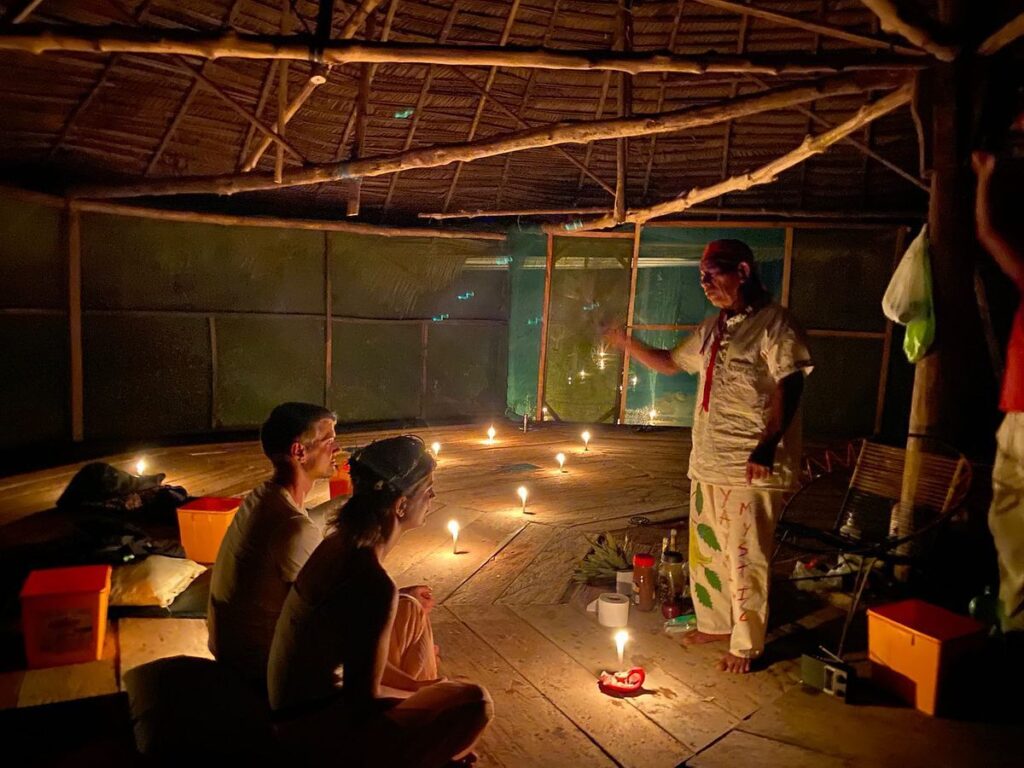
For many people, ceremony begins when the cup is placed in their hands.
But in deeper practice, ceremony often begins much earlier than that.
It begins in the way you prepare.
In the way you listen.
In the way you slow down enough to recognize that something sacred cannot be entered casually.
In many Amazonian and ceremonial contexts, ayahuasca is not approached as a sudden event, a performance, or an isolated experience. It is approached as a process. And like any real process, it begins before the visible moment.
The cup may open the night.
But the ceremony often begins long before you drink.
The way you arrive matters
People often focus on what they will feel, see, or experience during the ceremony itself. But the quality of what you bring into the space matters.
The mind you arrive with matters.
The emotional state you arrive with matters.
The level of noise you carry matters.
The sincerity of your intention matters.
This does not mean you must arrive perfectly calm, spiritually advanced, or emotionally resolved. It means that the way you enter the process shapes the quality of your relationship with it.
A ceremony is not only about what happens to you.
It is also about how you arrive to meet it.
Intention is not a demand
Many people are told to set an intention before ceremony. This can be helpful, but intention is often misunderstood.
An intention is not a demand placed on the experience.
It is not a way of controlling the night.
It is not a contract that guarantees visions, answers, or transformation.
A true intention is often simpler and more honest than that.
It may sound like:
“I want clarity.”
“I want to understand what I have been carrying.”
“I want to listen.”
“I want to come with respect.”
An intention does not need to be dramatic. It only needs to be real.
In this sense, intention is less about forcing a result and more about orienting the heart.
Silence is already part of the work
One of the reasons ceremony begins before drinking is that silence itself is already part of the medicine.
Many people arrive from lives filled with movement, stimulation, pressure, and mental noise. Even before the ceremony starts, the simple act of becoming quiet can begin revealing what has been hidden underneath the routine.
When conversation slows down, when the body becomes still, and when attention turns inward, something already begins to change.
You start to feel what has been waiting underneath distraction.
You begin to notice your restlessness.
Your expectation.
Your fear.
Your hope.
Your resistance.
This is why the moments before the ceremony matter.
They are not empty time.
They are already part of the encounter.
Respect changes the atmosphere
Ceremony is shaped not only by the healer or the songs, but by the atmosphere created by everyone present.
Respect changes that atmosphere.
The way people enter the space, the way they sit, the way they speak, the way they wait — all of this affects the energy of the night.
In many traditions, respect is not an abstract idea. It is practical. It is expressed through attention, humility, silence, listening, and care for the ceremonial container.
A person may drink ayahuasca without reverence.
But reverence changes the quality of the experience.
Respect does not make the process easy.
It makes it honest.
Preparation is part of ceremony
People sometimes think preparation is only about food restrictions or practical instructions. But preparation is deeper than that.
It includes the body, yes.
But it also includes attitude.
Preparation means recognizing that you are entering something that asks for presence. It means making space before the ceremony, not only in the schedule, but inside yourself.
This may include rest.
Simplicity.
Less stimulation.
More reflection.
More prayer.
More honesty.
Less performance.
In this sense, preparation is not separate from ceremony.
It is the first layer of ceremony.
The ceremony begins in your listening
Before the cup, there is already a question.
Why are you here?
Not the polished answer.
Not the spiritual answer you think you should give.
The real answer.
Why now?
What has brought you here?
What inside you is asking to be seen?
What have you been carrying in silence?
What are you ready to stop avoiding?
Often, ceremony begins the moment you become willing to listen to those questions without trying to escape them.
The medicine may deepen the encounter, but the first doorway is often listening.
You do not have to be ready in a perfect way
There is a difference between preparation and perfection.
Some people wait for the moment when they feel completely fearless, completely clear, or completely certain before they believe they are ready. But ceremony does not usually ask for perfection.
It asks for honesty.
You may arrive nervous.
You may arrive uncertain.
You may arrive with questions you cannot fully name.
That does not mean you are failing the process.
What matters more is whether you are willing to be sincere, respectful, and present. Ceremony often meets truth more deeply than performance.
The visible beginning is not the true beginning
From the outside, the ceremony may seem to begin when people gather, when the cup is served, or when the first icaro is sung.
But inwardly, the ceremony may have begun days earlier.
It may have begun when you made the decision to come.
When you admitted something had to change.
When you started becoming quieter.
When you felt fear and still chose honesty.
When you stopped approaching the process like curiosity alone and began approaching it with humility.
That is why the visible beginning is not always the real beginning.
Sometimes the ceremony begins the first moment you stop running from yourself.
Why this matters
Understanding that ceremony begins before drinking changes the way you approach the whole process.
It helps you see that the experience is not only about what the medicine shows, but about the quality of relationship you bring into the night.
It reminds you that silence matters.
Humility matters.
Atmosphere matters.
Respect matters.
Preparation matters.
And perhaps most importantly, it reminds you that ceremony is not something you consume.
It is something you enter.
Final reflection
Ayahuasca work begins long before the cup touches your hands.
It begins in your willingness to slow down.
To listen.
To prepare.
To arrive with honesty instead of performance.
With humility instead of demand.
With reverence instead of curiosity alone.
The ceremony may become visible in the night.
But often, it begins much earlier — in the quiet decision to stop treating the sacred like an event, and to begin meeting it as a relationship.
That is where the real doorway opens.